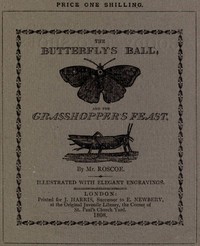
William Roscoe's The Butterfly's Ball and the Grasshopper's Feast, first published in 1807 by John Harris, opens with a formal invitation: the Butterfly sends his 'gay painted wings' to summon the Grasshopper. The poem's voice is that of a narrator who observes the gathering with a mix of stately description and light humor. The language is carefully metered, with each creature introduced in a quatrain or couplet that often mimics its movement—the Snail's 'majestic' advance, the Glow-worm's 'light' at dusk. The pace is deliberate at first, then quickens as the feast begins, with the creatures 'dancing' and 'chirping' until nightfall. Charles Welsh's 1883 introduction notes the poem's place in Harris's 'Cabinet' series and its immense popularity, with 40,000 copies sold of the first two titles.
Meter and Movement: How Rhyme Shapes the Creatures' Entrance
The poem's structure is built on rhyming couplets in iambic tetrameter, a rhythm that propels each creature's entrance. The Butterfly 'took but three Leaps, and was soon out of Sight'—the line's speed mirrors the insect's flight. In contrast, the Snail 'did advance' with 'Step so majestic,' and the meter slows, with a pause after 'majestic' to emphasize the snail's deliberate pace. The Grasshopper 'chirp'd his own Praises the rest of the Night,' a line that ends with a long vowel sound, suggesting a sustained song. Roscoe varies the couplet's closure: some lines end with a full stop, others with a comma, creating a sense of ongoing motion. The poem's voice remains consistent—a narrator who reports actions without moralizing, letting the creatures' behaviors speak for themselves.
The Shifting Pace from Invitation to Departure
The poem's pace is not uniform. It begins with a slow, ceremonial tone: 'Come, take up your Hats, and away let us haste.' The repeated 'Haste' and 'away' urge movement, but the actual procession is measured. As the feast progresses, the pace quickens: the creatures 'dance' and 'chirp,' and the lines become shorter, with more exclamation marks. The climax is the Glow-worm's entrance 'with a Light,' a sudden shift to darkness and urgency. Then the pace slows again with the child Robert's call to return: 'Then Home let us hasten, while yet we can see.' The final lines return to the steady rhythm of the opening, with the 'merry Companions' returning 'in a Throng.' This arc from invitation to feast to departure gives the poem a clear narrative shape, even within its brief 5616 words.
Voice and Observation: The Narrator's Detached Yet Playful Tone
The narrator maintains a detached, almost scientific tone, describing each creature's behavior without anthropomorphizing beyond the poem's conceit. The Snail 'promis'd the Gazers a Minuet to dance,' but the other creatures 'laugh'd so loud that he pull'd in his Head'—the humor comes from the narrator's deadpan report. The voice is consistent: it uses formal language ('With Step so majestic') but undercuts it with playful details ('He took but three Leaps'). The child Robert appears only at the end, speaking in a more colloquial register ('So said little Robert'), which contrasts with the narrator's elevated diction. This shift in voice marks the transition from fantasy to reality, as the child leads the creatures home. The narrator never intrudes with commentary, allowing the reader to observe the scene as if through a lens.
Readers may notice how Roscoe's poem balances formal verse with a child's perspective, a technique that made it accessible to young audiences in 1807. The facsimile edition preserves the original typography and illustrations, which complement the text's rhythmic structure. Pay attention to the way each creature's entrance alters the poem's tempo—a subtle but effective narrative device. The poem rewards multiple readings, as its precise language and shifting pace reveal new details about the insect world it portrays.
I found myself thinking back to Roscoe’s little feast, how each creature arrives with its own quiet purpose, and that reminded me of a different catalogue—this one of mammals in Michoacán. It’s strange, but that list carries a similar gentle order, a procession of names. An Annotated Check List of the Mammals of Michoacán, México — Story, Setting & Ideas feels like an old companion to that poem, both simply noting who came to the gathering.