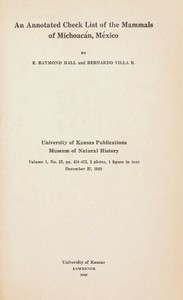
The checklist opens with a detailed account of the 1943 field expedition, naming every participant—from the Hall family to local collaborators—and specifying exact dates and locations. This meticulous framing establishes a collaborative, ground-level perspective before the text shifts into dense taxonomic descriptions. The authors' voice is notably personal in the introduction, with phrases like "we collected at, and in the vicinity of, Pátzcuaro" and acknowledgments of housing provided by Sr. Efrain Buenrostro. This contrasts sharply with the later sections, where the prose becomes compressed and data-driven.
From Field Narrative to Taxonomic Precision
The introduction reads almost like a travelogue: the party included the Halls' three sons, and the team moved between cottages and field camps. This narrative warmth evaporates once the species accounts begin. For example, the entry for Reithrodontomys fulvescens tenuis lists 27 specimens with precise coordinates and elevations—"11 mi. W Zamora, 5,750 ft., 2"—and then launches into comparative measurements: total length, tail length, hind foot, ear, basilar length, nasals, zygomatic breadth, mastoid breadth, rostrum breadth, interorbital constriction, tooth-row length, rostrum length. The shift from human-scale storytelling to tabular data is abrupt and deliberate.
Voice of Tentative Authority
Despite the confident taxonomic framework, the authors frequently hedge. In the Reithrodontomys fulvescens account, they write: "we are inclined to refer our specimens to R. f. tenuis although the reddish color, we suppose, is evidence of intergradation." Later, they admit: "we have not attempted to bring together all of the pertinent material from different collections as would be required for an ideally thorough analysis." This cautious language—"inclined," "we suppose," "we guess"—reveals the provisional nature of their identifications, especially when relying on "printed descriptions" rather than direct comparison of specimens.
Pacing Through Measurement Tables
The most striking change in pace occurs when the prose yields to measurement tables. A typical table lists 13 columns of cranial and external measurements for multiple specimens, organized by sex and locality. For instance, the table for Reithrodontomys fulvescens compares males and females from Valle de México, Pátzcuaro, Zamora, and Tacámbaro, with rows for total length, tail length, hind foot, basilar length, nasals, zygomatic breadth, mastoid breadth, and tooth-row length. These tables interrupt the narrative flow, forcing the reader to slow down and compare figures. The effect is a rhythmic alternation between descriptive text and numerical evidence, mirroring the scientific process of observation and quantification.
Readers should pay attention to how the authors balance firsthand field experience with secondhand taxonomic judgment. The checklist is not merely a list but a document of scientific decision-making under uncertainty. The frequent qualifications—"we guess," "we are inclined"—invite scrutiny of the evidence. For those interested in the history of mammalogy, the introduction offers a rare glimpse into mid-century field practices, while the species accounts demonstrate the painstaking work of distinguishing subspecies through measurement and comparison.
This checklist’s dry, precise naming made me think of summer afternoons with my grandfather, turning pages of Fabre's Book of Insects — Text and Context. Both books slow time down, making each creature feel like a quiet secret worth waiting for. I remember that same patient hush, the world shrinking to one small, exact observation.