About 404 minutes
The Life of the Grasshopper — Background and Themes
Insects
92,793 recorded words. 280 minutes difference from this book's estimate.
View Gutenberg source #66650
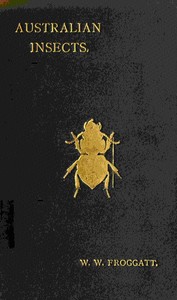
Australian insects — Reading Companion can be approached with a clearer sense of reading commitment from its source measurements: 157,094 words, 11 hr 24 min estimated reading time, and 39 detected text sections.
The text analysis averages about 24.6 words per sentence, while the detected sections provide another way to judge how the source is divided.
Project Gutenberg metadata also associates the work with “Insects -- Australia,” connecting these edition facts with the source record’s subject description.
Explore this collection
These alternatives are selected using recorded categories and estimated reading time.
About 404 minutes
Insects
92,793 recorded words. 280 minutes difference from this book's estimate.
View Gutenberg source #66650About 373 minutes
Insects
85,746 recorded words. 311 minutes difference from this book's estimate.
View Gutenberg source #45369About 298 minutes
Insects
68,446 recorded words. 386 minutes difference from this book's estimate.
View Gutenberg source #67000Search stored excerpts and compare books → Choose by your preferences →
Choices use stored catalog measurements. Estimates vary with reading speed. A shared category is a catalog label, not a claim that two books have the same argument or literary quality.
Search reads excerpt text stored with this catalog and links to its associated Gutenberg record. The connection is stored in the site database; this tool does not recheck that every excerpt is word-for-word identical to that external record. Excerpt search does not cover every chapter and does not verify historical publication dates.
Catalog snapshot checked: 2026-09-26. Coverage: 96 public books, 96 available source excerpts.
Calculated from edition completeness, EPUB availability, text structure and catalogue metadata. Not a user rating.
Total of 100 points, scaled to a 2.5-5.0 range. Editions with an empty description or a missing EPUB file are not scored.
Public-domain source text
The source text is kept in the dedicated reader, separate from this catalogue record and its commentary.
Walter W. Froggatt opens his 1907 textbook by addressing a practical gap: the lack of a single volume covering Australian insects for both the general reader and the serious student. He notes that since 1770, descriptions of Australian insects have been scattered across rare foreign publications and scientific society transactions, many in Latin, making them inaccessible to beginners. Froggatt aims to write in a “popular style” while preserving the taxonomic detail needed for a reference work. This dual purpose shapes the entire book, as he frequently shifts between broad ecological observations and precise anatomical terminology.
Froggatt’s preface is not a mere courtesy; it is a methodological statement. He acknowledges the difficulty of reconciling popular appeal with scientific rigor, and he names the earlier entomologists whose work he builds upon—Westwood, Walker, and others. He criticizes Walker’s “vague descriptions, without details or figures” that have puzzled later specialists. This frank assessment signals that Froggatt intends his own descriptions to be clearer and more usable. The preface also reveals the book’s historical moment: by the 1900s, new collections from previously inaccessible parts of Australia had made a comprehensive synthesis possible. Readers who skip the preface miss the author’s explicit rationale for the book’s structure and his debts to earlier workers.
In the section on moths (Heterocera), Froggatt juxtaposes technical wing-venation diagrams with practical advice: “the larger species may be killed at once in the cyanide bottle, but must be transferred to a box as soon as they are dead, for they rub very easily.” He explains the difference between butterflies and moths by describing the abdomen and antennae, then immediately gives field-collecting tips. This pattern recurs throughout the excerpts: a formal definition is followed by a hands-on note. For example, after detailing the “connecting-link moths” (Castniidae), he adds that they are “chiefly confined to South America and Australia,” a biogeographical aside that enlivens the taxonomy. The reader learns both the Latin names of wing veins and the best way to handle a specimen.
Froggatt frequently anchors his general descriptions with named species and their distinguishing features. Of the skipper butterflies, he writes that Hasora discolor has an under surface “richly marked with purple and pale golden yellow,” while H. hurama has “simple silvery stripes.” These precise color notes give the reader concrete images to hold onto amid the taxonomic lists. Similarly, the vine moth Agarista glycine is cited as an exception to the nocturnal habit of most moths. Such examples are not random; they are chosen to illustrate a broader point—here, that diurnal flight is rare among moths. By linking a memorable species to a general rule, Froggatt helps the beginner build a mental framework for identification.
Throughout the excerpts, Froggatt addresses the reader as a potential collector. He describes how to obtain moths by “shaking the bushes over a net” and advises on killing and mounting specimens. The section on moth caterpillars notes that many “bury themselves in the ground, or pupate in cavities in timber,” information that is both biological and practical—it tells the collector where to look. Even the technical wing diagram (Fig. 112) is a tool for identification, not mere ornament. The book assumes that its user will be handling insects, not just reading about them. This orientation toward active engagement distinguishes Froggatt’s text from a purely descriptive catalog and makes it a field companion as much as a reference work.
Froggatt’s Australian Insects rewards a reading that moves between the preface’s methodological candor, the technical descriptions, and the practical collecting advice. The book is best approached not as a linear narrative but as a resource to be dipped into: the preface explains why it was written, the early chapters establish the author’s voice, and the later species accounts provide the granular detail that gives the work its lasting value. Readers new to entomology may find the anatomical diagrams daunting, but the frequent asides on behavior and habitat offer an accessible entry point.
Froggatt's Australian Insects — Reading Companion taught me patience with tiny, fractured records — how scattered observations can still build a quiet whole. That same patient, comparative wonder stirs when I return to the chimpanzee parietal study, where a single bone reveals its own unexpected seams. Two books, different worlds, yet both whisper of hidden connections. A Bilateral Division of the Parietal Bone in a Chimpanzee; with a Special Reference to the Oblique Sutures in the Parietal — Key Ideas to Explore sits beside it on my shelf, a fellow traveler in gentle scrutiny.
Your answers remain private and are stored only in this browser.