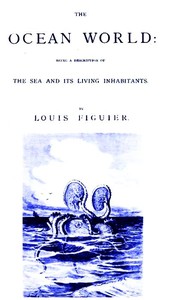
Louis Figuier's The Ocean World (1869) opens with a striking structural gambit: a preface that frames the ocean as one of two great oceans enveloping the planet—the visible and the invisible. This binary sets up a work that constantly shifts between the tangible and the wondrous, the catalogued and the sublime. The book's 29 text sections move from general descriptions of the sea's physical properties to detailed accounts of its inhabitants, but Figuier repeatedly interrupts taxonomic exposition with lyrical set-pieces, such as Schleiden's vision of diving into the Indian Ocean's 'liquid crystal.' The result is a text that oscillates between the stance of a naturalist and that of a travel writer, using vivid imagery to bridge the gap between scientific observation and popular wonder.
Movement Between Scales
Figuier's narrative structure is defined by rapid shifts in scale. A paragraph may begin with the vastness of ocean currents and then zoom in to the microscopic anatomy of a single ascidian. This technique is not merely stylistic; it mirrors the book's argument that the ocean's grandeur is built from countless small lives. For instance, the description of Pyrosoma colonies begins with their phosphorescent 'long trains of fire' visible from a ship, then narrows to the individual zooids that compose the 'moving republic.' The reader is constantly asked to hold both perspectives simultaneously—the mile-wide shoal and the gelatinous cylinder of cooperating creatures. This structural oscillation creates a rhythm of awe and analysis, preventing the text from settling into a dry catalogue.
Light as a Recurring Image
Phosphorescence is the book's most persistent visual motif. Figuier returns to it across multiple chapters, from the 'brilliant and dazzling light' of Pyrosoma to the 'pale greenish light' of Pyrosoma atlanticum caught in a towing-net. The descriptions are precise: colors shift 'with wonderful rapidity from the most intense red to yellow, from golden colour to orange, to green, or to azure blue.' This recurring image does more than decorate; it becomes a structural thread linking disparate sections. The same quality that makes Beroë cilia remarkable reappears in the colonial ascidians, suggesting a hidden unity in marine life. Figuier uses light to connect the microscopic and the oceanic, the individual and the mass—a visual echo that ties the book's diverse subjects together.
Colonial Animals as Political Metaphors
Figuier's descriptions of colonial organisms are laced with social and political language. The Botryllus star is 'a kind of union and communism of which the moral world presents no prototype.' Pyrosoma is called a 'moving republic' and a 'forced species of socialism.' These metaphors are not incidental; they structure the reader's understanding of how these animals live. Figuier emphasizes that in these colonies, 'animals which eat separately' fulfill 'together as a community very singular functions.' The language of politics gives the reader a familiar framework for grasping unfamiliar biology. Yet the metaphors also carry an edge: the 'alliance imposed by inexorable Nature' suggests a determinism that contrasts with human ideals of voluntary association. This tension between natural law and social analogy recurs throughout the book, inviting reflection on the relationship between human and animal societies.
The Role of First-Hand Accounts
Figuier frequently cedes the narrative to eyewitnesses, embedding their reports as evidence of the ocean's marvels. The Brazilian navigator Bibra, who used captured Pyrosoma to light his cabin, appears alongside Humboldt, who observed 'circles of light having a radius of not less than twenty inches in diameter.' Mr. Bennet's account of a mile-wide phosphorescent shoal is quoted at length, including the mate's call to witness 'a very unusual appearance in the water.' These voices serve a structural purpose: they break the authorial monologue and provide concrete, temporal anchors—specific latitudes, dates, and shipboard routines. The effect is to ground the most extraordinary claims in the credibility of trained observers, while also adding a layer of human drama. The reader is reminded that these wonders were seen by real people, not merely deduced from specimens.
Readers approaching The Ocean World will find a work that rewards attention to its compositional choices. The interplay between scientific description and narrative set-piece, the recurrence of light as a unifying image, and the political language applied to animal colonies all invite a reading that is as much about the structure of knowledge as about marine life. Figuier's book is best enjoyed not as a reference but as a journey—one that moves between the deck of a ship and the interior of a jellyfish, between the vast and the minute, always seeking the pattern that connects them.
Figuier’s sea glows with its own patient light, each creature a small pulse in a vast, breathing dark. I find that same quiet wonder in the Kansas fishes, their lives recorded with a gentle, exacting care. Both books whisper that hidden order, that kinship of fins and foam, was always there—just waiting for a steady hand. Fishes of Chautauqua, Cowley and Elk Counties, Kansas — Inside the Classic holds that same unhurried reverence for simple life.