About 936 minutes
The Ocean World: Being a Description of the Sea and Its Living Inhabitants. — Story, Setting & Ideas
Marine Life
215,262 recorded words. 377 minutes difference from this book's estimate.
View Gutenberg source #47626
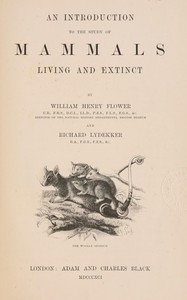
An introduction to the study of mammals living and extinct — Inside the Classic can be approached with a clearer sense of reading commitment from its source measurements: 301,909 words, 21 hr 53 min estimated reading time, and 60 detected text sections.
The text analysis averages about 20.9 words per sentence, while the detected sections provide another way to judge how the source is divided.
Project Gutenberg metadata also associates the work with “Mammals,” connecting these edition facts with the source record’s subject description.
Explore this collection
These alternatives are selected using recorded categories and estimated reading time.
About 936 minutes
Marine Life
215,262 recorded words. 377 minutes difference from this book's estimate.
View Gutenberg source #47626About 823 minutes
Marine Life
189,100 recorded words. 490 minutes difference from this book's estimate.
View Gutenberg source #62011About 314 minutes
Marine Life
72,053 recorded words. 999 minutes difference from this book's estimate.
View Gutenberg source #77045Search stored excerpts and compare books → Choose by your preferences →
Choices use stored catalog measurements. Estimates vary with reading speed. A shared category is a catalog label, not a claim that two books have the same argument or literary quality.
Search reads excerpt text stored with this catalog and links to its associated Gutenberg record. The connection is stored in the site database; this tool does not recheck that every excerpt is word-for-word identical to that external record. Excerpt search does not cover every chapter and does not verify historical publication dates.
Catalog snapshot checked: 2026-09-26. Coverage: 96 public books, 96 available source excerpts.
Calculated from edition completeness, EPUB availability, text structure and catalogue metadata. Not a user rating.
Total of 100 points, scaled to a 2.5-5.0 range. Editions with an empty description or a missing EPUB file are not scored.
Public-domain source text
The source text is kept in the dedicated reader, separate from this catalogue record and its commentary.
The preface of this 1891 volume immediately signals a tension between comprehensiveness and accessibility. The authors acknowledge the difficulty of determining “the amount of detail desirable” for the ordinary student without making the book too bulky or costly. This framing prepares the reader for a work that is selective rather than exhaustive, with some groups described at length and others treated briefly. The preface also reveals the book’s composite nature: it is based largely on the senior author’s articles for the ninth edition of the Encyclopædia Britannica, supplemented by contributions from specialists such as Dr. G. E. Dobson and Mr. Oldfield Thomas. A first-time reader should therefore expect a text that is both a synthesis and a collaborative effort, not a wholly original monograph.
The preface is more than a courtesy; it is a practical guide to the book’s structure and limitations. The authors state that they have selected references “likely to prove most valuable to the student for the amount of original information which they contain,” and they note that new generic terms proposed by Mr. Lydekker are explicitly marked. This transparency about authorship and sourcing is unusual for its time and helps the reader assess the authority of each section. The preface also explains that the work incorporates material from other writers, including Dr. St. G. Mivart on apes and Mr. Oldfield Thomas on rodents and other groups. For a first reading, this means that the voice and depth may shift between chapters, and the reader should not assume uniform treatment across all orders.
The excerpts on horses, asses, and zebras illustrate the book’s method. The authors describe the Asiatic wild asses as forming “but a single species (E. hemionus)” despite “marked variations in size and form,” and they note that the Kiang is “considerably larger” and “differs from them in external appearance, having more the aspect of the horse.” This careful weighing of morphological evidence against taxonomic tradition is typical of the work. The account of the quagga is particularly vivid: it mentions that the animal was “formerly met with in vast herds” but is now “becoming extremely scarce, owing to the encroachments of European civilisation.” The authors also note that the name “quagga” is an imitation of its call—“ouag-ga, ouag-ga”—and caution that hunters often apply the same word to Burchell’s zebra. Such details ground the taxonomy in natural history observation and contemporary context.
The text frequently references figures, such as “Fig. 160. —The Quagga (Equus quagga),” and describes a painting made from a pair driven in Hyde Park. These references remind the reader that the book is designed to be used alongside its plates, which are not included in the digital text. The authors also rely on external authorities: the account of the quagga’s extinction threat is presented without citation, but the preface’s acknowledgment of contributions from specialists suggests that such statements are drawn from contemporary reports. The reader should be aware that the digital edition omits the visual material that was integral to the original publication, and that some claims may reflect the state of knowledge in 1891 rather than current science.
The excerpts give only a narrow window into the book’s overall organization. The preface indicates that the work covers all mammalian orders, with varying levels of detail. The equid section is relatively extended, but the preface warns that other groups are treated “with much greater brevity.” The inclusion of extinct forms is noted as new matter added by Lydekker. A first-time reader might use the table of contents (not provided in the excerpts) to navigate to groups of interest, and should expect that the depth of treatment will vary. The book is not a field guide but a systematic survey, and the reader who wants a quick reference may need to supplement it with more modern works. The collaborative nature of the text means that the style and emphasis may shift from chapter to chapter.
This work is best approached as a historical document of late-Victorian zoology, reflecting both the strengths and the limitations of its era. The reader should note the authors’ explicit reliance on external contributors and the selective depth of treatment. The digital edition lacks the original illustrations, which were clearly important to the text. For a first reading, focus on the preface’s guidance and the detailed treatment of a few groups, such as the equids, to understand the authors’ method. The book is not a comprehensive modern reference, but a valuable snapshot of how mammals were studied and classified in the late nineteenth century.
There’s something tender about old surveys, how they trust the reader to find their own way. Flower and Lydekker’s earnest footnotes feel like a hand on a gate latch. I keep thinking of another quiet waterway, its species listed without fuss, the way you’d memorize a neighbor’s name. That patience lingers—Fishes of the Wakarusa River in Kansas — A Reader’s Guide—as if naming things slowly is its own kind of goodbye.
Save your reaction, strongest insight, and memorable passage.