About 269 minutes
Children of the Wild — Inside the Classic
Animals
61,829 recorded words. 4 minutes difference from this book's estimate.
View Gutenberg source #16077
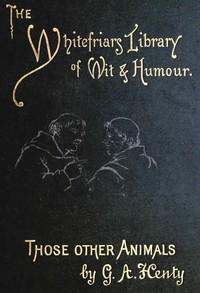
Those Other Animals — Inside the Classic can be approached with a clearer sense of reading commitment from its source measurements: 62,612 words, 4 hr 33 min estimated reading time, and 40 detected text sections.
The text analysis averages about 28.6 words per sentence, while the detected sections provide another way to judge how the source is divided.
Project Gutenberg metadata also associates the work with “Animals -- Humor,” connecting these edition facts with the source record’s subject description.
Explore this collection
These alternatives are selected using recorded categories and estimated reading time.
About 269 minutes
Animals
61,829 recorded words. 4 minutes difference from this book's estimate.
View Gutenberg source #16077About 249 minutes
Animals
57,254 recorded words. 24 minutes difference from this book's estimate.
View Gutenberg source #27933About 244 minutes
Animals
56,120 recorded words. 29 minutes difference from this book's estimate.
View Gutenberg source #76132Search stored excerpts and compare books → Choose by your preferences →
Choices use stored catalog measurements. Estimates vary with reading speed. A shared category is a catalog label, not a claim that two books have the same argument or literary quality.
Search reads excerpt text stored with this catalog and links to its associated Gutenberg record. The connection is stored in the site database; this tool does not recheck that every excerpt is word-for-word identical to that external record. Excerpt search does not cover every chapter and does not verify historical publication dates.
Catalog snapshot checked: 2026-09-26. Coverage: 96 public books, 96 available source excerpts.
Calculated from edition completeness, EPUB availability, text structure and catalogue metadata. Not a user rating.
Total of 100 points, scaled to a 2.5-5.0 range. Editions with an empty description or a missing EPUB file are not scored.
Public-domain source text
The source text is kept in the dedicated reader, separate from this catalogue record and its commentary.
G. A. Henty, best known for his adventure stories, here turns his hand to a very different kind of writing: a series of humorous essays that deliberately invert the usual moral rankings of the animal kingdom. The book opens with a direct challenge to the reader, arguing that humanity judges animals solely by their usefulness, praising the bee for its honey while ignoring the superior industry and intelligence of the wasp. This contrarian stance sets the tone for the entire collection, as Henty proceeds to champion the maligned and dethrone the revered.
First published in the Evening Standard, these essays are not scientific treatises but playful provocations. Henty adopts a mock-serious voice, treating his subjects with a blend of factual observation and ironic moralizing. The result is a work that is as much a commentary on human prejudice as it is a study of animal behavior.
Henty’s most sustained argument is his rehabilitation of the wasp at the expense of the bee. He asserts that the wasp surpasses the bee in both industry and intelligence, a claim he supports by noting the wasp’s ability to build intricate nests from chewed wood and its role as a predator of pests. The bee, he suggests, is overrated simply because humans profit from its honey. This reversal is typical of Henty’s method: he takes a creature universally disliked and presents it as a model of virtue, while the beloved bee is shown to be selfish and unremarkable. The essay on the wasp is a masterclass in rhetorical inversion, using the same criteria of utility that humans apply to animals to argue for the wasp’s superiority.
In his essay on the cockroach, Henty paints a vivid picture of a creature that is both reviled and fascinating. He notes its omnivorous diet, including a taste for boot blacking and beer, and its silent but communicative nature, with cockroaches seen ‘standing head to head in close confabulation.’ Henty draws a moral distinction between the cockroach and other insects, calling it ‘the rats of the insect world’ and suggesting that even other insects shun it. The essay is notable for its blend of precise observation—such as the cockroach’s preference for intoxicating liquids—and humorous anthropomorphism, as when Henty speculates that cockroaches would devour a bishop if given the chance. This combination of fact and fancy is a hallmark of the collection.
Henty’s essay on mice begins with a puzzle: why do women, who are brave in shipwrecks and sieges, feel ‘abject terror’ at the sight of a mouse? He describes the mouse as ‘one of the most harmless and inoffensive of created things,’ noting its soft coat, bright eye, and capacity for affection and tricks. The essay contrasts the male view of the mouse as a charming pet with the female terror that Henty finds ‘absolutely unaccountable.’ This observation serves as a springboard for a broader reflection on irrational fear and the ways in which cultural attitudes shape our responses to animals. Henty does not resolve the mystery but leaves it as a testament to the complexity of human-animal relations.
Henty’s essays are best read as rhetorical performances rather than natural history. He adopts the persona of a contrarian moralist, using irony and exaggeration to expose the inconsistencies in human attitudes toward animals. Readers will find the most pleasure in the essays on the most despised creatures—the wasp, the cockroach, the slug—where Henty’s wit is sharpest. The illustrations by Harrison Weir add a visual dimension to the humor, depicting the animals with a dignity that contrasts with their lowly reputations.
Years at this desk have taught me that jokes often house the gentlest truths. Henty’s creatures remind me of the quiet regard in that other volume, whose scaly residents also wait for patience rather than praise. A cockroach defended, a lizard observed—both ask only for a slower glance. Amphibians and Reptiles in Captivity — Themes and Context shares that same unhurried warmth, like a hand resting on a vivarium glass.
Save your reaction, strongest insight, and memorable passage.









