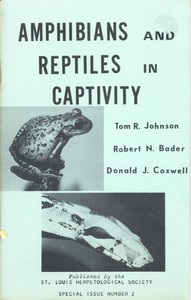
The authors of this 1975 special issue of the St. Louis Herpetological Society open with a frank admission: pet stores “generally do not have the expertise” to advise on amphibian and reptile care, and existing booklets are “too general and too vague.” Their response is a compact, species-by-species manual that balances practical husbandry with clear ethical boundaries. The preface explicitly states that venomous snakes and most crocodilians “do not belong in a private collection,” a stance that sets the tone for a guide more concerned with animal welfare than with expanding a hobbyist’s menagerie.
A Cautious, Experience-Based Voice
The authors repeatedly qualify their authority. They write, “We are by no means THE experts on the subject, nor do we claim to cover all the facts.” This humility is matched by a direct, instructional style. In the lizard section, they warn that “keeping lizards healthy can be a challenging but also frustrating experience” and note that “there is very little information available on lizard diseases.” Rather than offering guarantees, they emphasize observation: “If the lizard is alone, keep track of its food intake and fecal output.” The prose is lean, avoiding the promotional language common in pet-care literature of the era.
Diction That Prioritizes Prevention Over Cure
Throughout the excerpts, the authors stress preventive measures. For lizards, they write, “The best cure is preventive procedures,” and recommend feeding “a variety of insects if possible, but don’t feed all meal worms.” For snakes, they note that “a common problem with keeping snakes is they often will not eat,” and the solution is not force-feeding but ensuring the environment meets the animal’s needs. The word “require” appears frequently—salamanders “require a moist environment,” snakes “require clean drinking water”—underscoring a philosophy that the keeper must adapt to the animal, not the reverse.
Structure: A Compact, Species-by-Species Format
The booklet is organized by taxonomic group—Salamanders, Toads and Frogs, Turtles and Tortoises, Lizards, Snakes—each section beginning with a brief “Background” paragraph. Within these, the authors list species that “usually can be kept successfully” and those that “do not make good pets.” For example, under Lizards, they recommend green iguanas, tegus, and monitors, but advise against horned lizards, anoles, collared lizards, and fence lizards. This binary classification, based on the authors’ collective experience, gives the guide a practical, no-nonsense utility.
Recurring Details: Temperature, Diet, and Ethical Limits
Temperature control is a recurring concern. The authors advise, “Never guess at the cage temperature—always have a small thermometer in the cage, and check it often.” Diet is another constant: snakes are “all carnivorous” and “eat only whole animals,” while lizards may need “a variety of insects.” The ethical line drawn in the introduction—excluding venomous reptiles and crocodilians—is not repeated in later sections, but it shapes the overall scope. The guide is explicitly for the amateur herpetologist, and the authors assume a responsible, informed reader who will consult the bibliography for deeper study.
This guide is best read as a starting point, not a definitive manual. The authors direct readers to the bibliography for “more detail on amphibians and reptiles: their identification, and natural history, range, and care in captivity.” The value of the booklet lies in its candid, experience-based advice and its clear ethical stance. For anyone keeping herps in the 1970s—or today—it offers a concise, no-frills foundation built on the principle that knowing an animal’s natural history is the key to keeping it healthy.
That rainy afternoon, I kept returning to Johnson’s warnings about crocodilians, their calm bulk masking an ancient impatience. It made me wonder about animals whose wildness we’ve quietly negotiated away, not just tamed but reshaped. So I set down the herpetology guide and picked up Domesticated animals — Reading Notes, following a thread of caution into something gentler, yet equally strange.