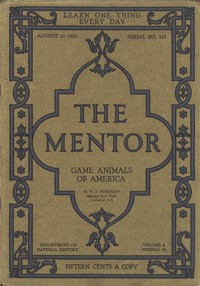
The Mentor issue on Game Animals of America opens with a stark declaration: the hunting of big game in North America is 'fast becoming an extinct pastime.' W. T. Hornaday, director of the New York Zoological Park, immediately establishes a tone of loss and urgency. The text is framed by a foreword from Theodore Roosevelt, who describes the 'shrinkage' of wildlife since the Revolutionary War and calls for preservation. This is not a neutral natural history; it is a conservationist argument built on specific, often grim, observations about vanishing species.
A Structure of Loss and Description
The issue alternates between broad lament and precise natural history. The opening pages list extinctions and near-extinctions: the bison is 'gone,' antelope hunting is 'gone, forever,' the Arizona elk is 'totally extinct.' This pattern of loss sets up each subsequent monograph. The mountain sheep section, for instance, begins with its former abundance and then details its current scattered, diminished state. Hornaday’s prose moves from the general—'the most striking and melancholy feature'—to the particular: the big-horn’s gray-brown color, the female’s short horns, the lamb’s vulnerability to eagles. This structure forces the reader to see each animal not as a static specimen but as a species in retreat.
Recurring Images of Vertical Terrain
Across the excerpts, the animals are defined by their relationship to steep, high ground. The mountain sheep favors 'treeless slopes above the timber-line' and descends only reluctantly in winter. The Rocky Mountain goat is described as 'the most expert and daring rock climber of all American hoofed animals,' capable of crossing 'walls of rock which neither man, dog nor mountain sheep would dare attempt.' Hornaday emphasizes the goat’s specialized hoofs—'a combination of rubber-pad inside and knife-edge outside'—that allow it to grip snow, ice, or bare rock. These repeated images of verticality create a sense of animals clinging to the last refuges, places that are both spectacular and inaccessible.
Movement Between Panorama and Detail
Hornaday shifts rapidly between sweeping geographic ranges and minute physical traits. The mountain sheep, he notes, are 'scattered from the northern states of Mexico through the Rocky Mountains, almost to the shore of the Arctic zone.' Then, within the same paragraph, he specifies the length of the female’s horns: 'from five to eight inches.' The goat’s habitat extends 'from northwestern Montana to the head of Cook Inlet,' but the text immediately zooms in on its 'small, angular and very compact' hoofs. This movement—from continent-wide distribution to a single anatomical feature—mirrors the issue’s dual purpose: to survey what remains and to document what is being lost.
The Conservationist Frame and Its Limits
Theodore Roosevelt’s foreword sets a moral tone: 'every lover of nature… should strike hands with the far-sighted men who wish to preserve our material resources.' Hornaday echoes this, but the excerpts provide only glimpses of the proposed solutions. The text mentions that the bison is 'gone' and antelope hunting 'gone, forever,' but does not explain the mechanisms of conservation or the role of laws or reserves. The focus remains on the animals themselves—their appearance, behavior, and dwindling numbers. Readers are left with a vivid sense of loss but only a partial picture of the preservation efforts Roosevelt alludes to. The issue is more a eulogy than a policy paper.
This issue of The Mentor is best read as a period piece that captures a specific moment in American conservation thought. Hornaday’s descriptions are precise and evocative, but they are also selective—each animal is presented as a case study in decline. The reader should note that the text assumes a hunting audience and measures value partly in terms of sport. The recurring images of high, dangerous terrain and the structural alternation between loss and natural history detail give the work a distinctive rhythm, one that is as much about the vanishing wilderness as about the animals themselves.
I couldn't stop thinking about how those old hunting accounts treat animals as fleeting presences, almost ghosts already. It reminded me of a quieter book, Letters from a Cat Published by Her Mistress for the Benefit of All Cats and the Amusement of Little Children — A Closer Reading, where the cat’s voice feels just as tender and impermanent, like a small life speaking from the edge of memory.