About 73 minutes
Poisonous Dwellers of the Desert — Inside the Classic
Animals
16,789 recorded words. 3 minutes difference from this book's estimate.
View Gutenberg source #54548
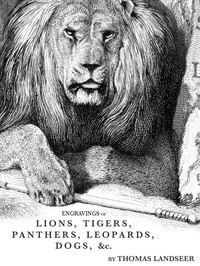
Engravings of Lions, Tigers, Panthers, Leopards, Dogs, &c. — A Reader’s Guide can be approached with a clearer sense of reading commitment from its source measurements: 16,055 words, 1 hr 10 min estimated reading time, and 5 detected text sections.
The text analysis averages about 22.7 words per sentence, while the detected sections provide another way to judge how the source is divided.
Project Gutenberg metadata also associates the work with “Landseer, Edwin Henry, Sir, 1802-1873,” connecting these edition facts with the source record’s subject description.
Explore this collection
These alternatives are selected using recorded categories and estimated reading time.
About 73 minutes
Animals
16,789 recorded words. 3 minutes difference from this book's estimate.
View Gutenberg source #54548About 80 minutes
Animals
18,375 recorded words. 10 minutes difference from this book's estimate.
View Gutenberg source #44057About 83 minutes
Animals
19,052 recorded words. 13 minutes difference from this book's estimate.
View Gutenberg source #44058Search stored excerpts and compare books → Choose by your preferences →
Choices use stored catalog measurements. Estimates vary with reading speed. A shared category is a catalog label, not a claim that two books have the same argument or literary quality.
Search reads excerpt text stored with this catalog and links to its associated Gutenberg record. The connection is stored in the site database; this tool does not recheck that every excerpt is word-for-word identical to that external record. Excerpt search does not cover every chapter and does not verify historical publication dates.
Catalog snapshot checked: 2026-09-26. Coverage: 96 public books, 96 available source excerpts.
Calculated from edition completeness, EPUB availability, text structure and catalogue metadata. Not a user rating.
Total of 100 points, scaled to a 2.5-5.0 range. Editions with an empty description or a missing EPUB file are not scored.
Public-domain source text
The source text is kept in the dedicated reader, separate from this catalogue record and its commentary.
Thomas Landseer's Engravings of Lions, Tigers, Panthers, Leopards, Dogs, &c. (1853) is a work that moves between two distinct modes: the visual precision of the engraved plates and the discursive prose of the accompanying essay on the Carnivora. The volume reprints plates originally published between 1823 and 1828, chiefly after designs by Sir Edwin Landseer, engraved by Thomas. The structure juxtaposes a series of twenty-seven plates—ranging from lions after Rubens to a portrait of a dog-fox cross—with a text that debates the taxonomy of panthers and leopards. This note traces how the book's arrangement creates a dialogue between artistic representation and natural history classification.
The plates are organized not by species but by a logic of contrast and repetition. The frontispiece, a lion couchant by Edwin Landseer, establishes a calm, heraldic pose. This is followed by a leopard after Ridinger, then lions after Rubens—a shift from static to dynamic composition. The sequence alternates between single animals and groups: a tiger from nature, leopards after Rubens, a contending group. Plate 6, 'Contending Group, from Nature,' introduces physical struggle, a motif that recurs in Plate 7's lion and snake. The inclusion of dogs—Neptune, a Newfoundland; Brutus, a terrier; a cross of dog and fox—broadens the scope beyond big cats. The final plates return to hounds and a bloodhound's head, creating a circular movement from wild to domestic.
The essay on the Carnivora, signed 'J. Lan,' is not a general introduction but a focused investigation into the distinction between panthers and leopards. It cites Shaw, Griffith, Lichtenstein, and Cuvier, weighing their conflicting criteria: number of spot rows, tail length, and geographic origin. The author notes that 'Linnæus himself has confounded the Panther with the Leopard' and that 'a true distinctive mark between them, is by no means easy to communicate either by description or even by figure.' This admission of uncertainty contrasts with the plates' confident visual delineations. The essay moves from ancient authorities (Cicero, Pliny) to contemporary menagerie observations, including Mr. Cross's insistence that no specific difference exists between Asian and African specimens. The text thus mirrors the plates' oscillation between clarity and ambiguity.
Several plates are explicitly tied to specific locations: 'Lioness and Bitch, from Cross’s Menagerie' (Plate 17) and 'Tiger and Indian Bullock, from Nature' (Plate 19). These captions anchor the images in observed reality, yet the essay complicates this by noting that the same menagerie exhibited a leopard that 'should, according to Shaw, seem to be the Panther.' The book thus shuttles between the menagerie as a site of direct encounter and the museum as a space of comparative anatomy. The frontispiece and the 'Lion and Snake' plate evoke a more allegorical tradition, while the dogs—especially 'Brutus, a Terrier' and 'Vixen, a Scotch Terrier'—suggest portraiture. This range of settings—from Rubens's mythological lions to a bloodhound's head study—creates a layered visual argument about how animals are known.
The book's structure invites the reader to move back and forth between the essay and the plates. The essay's detailed discussion of spot patterns in panthers and leopards directly corresponds to plates 2, 5, 12, 13, and 14, which depict these animals. Yet the essay never references specific plates; the connection is left implicit. This gap forces the reader to test the textual criteria against the visual evidence. Similarly, the list of plates includes designers and engravers—Spilsbury, Stubbs, Rembrandt, Ridinger—creating a chain of authorship that the essay ignores. The volume thus operates as a kind of visual encyclopedia, but one that acknowledges the limits of both image and text. The final plates of dogs, which are not discussed in the essay, suggest a quiet coda: the domestic animal as a counterpoint to the taxonomic puzzle of the wild.
Readers may find it productive to examine the plates in the order they appear, noting how the sequence builds contrasts in posture, setting, and species. The essay can be read as a companion that raises questions rather than settles them. Pay attention to the captions: they often specify the source ('from Nature,' 'after Rubens'), hinting at the different modes of representation at play. This is a book that rewards slow looking and cross-referencing between word and image.
Landseer’s engravings linger on the stillness beneath the predator’s muscle, that patient pause before motion. I found myself thinking of Living lights — Themes and Context the other evening, not for beasts but for their borrowed glow—how both books ask us to watch something luminous without needing to name it. Just a quiet flicker of association, really.
Your answers remain private and are stored only in this browser.









