About 55 minutes
Amphibians and Reptiles in Captivity — Themes and Context
Animals
12,504 recorded words. 28 minutes difference from this book's estimate.
View Gutenberg source #59342
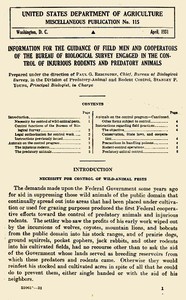
The source record for Information for the Guidance of Field Men and Cooperators of the Bureau of Biological Survey Engaged in the Control of Injurious Rodents and Predatory Animals — Reading Notes measures this digital text at 5,990 words, 27 min estimated reading time, and 1 detected text section.
The text analysis averages about 28.3 words per sentence, while the detected sections provide another way to judge how the source is divided.
Project Gutenberg metadata also associates the work with “Rodents -- Control -- United States,” connecting these edition facts with the source record’s subject description.
Explore this collection
These alternatives are selected using recorded categories and estimated reading time.
About 55 minutes
Animals
12,504 recorded words. 28 minutes difference from this book's estimate.
View Gutenberg source #59342About 56 minutes
Animals
12,690 recorded words. 29 minutes difference from this book's estimate.
View Gutenberg source #32069About 56 minutes
Animals
12,794 recorded words. 29 minutes difference from this book's estimate.
View Gutenberg source #49639Search stored excerpts and compare books → Choose by your preferences →
Choices use stored catalog measurements. Estimates vary with reading speed. A shared category is a catalog label, not a claim that two books have the same argument or literary quality.
Search reads excerpt text stored with this catalog and links to its associated Gutenberg record. The connection is stored in the site database; this tool does not recheck that every excerpt is word-for-word identical to that external record. Excerpt search does not cover every chapter and does not verify historical publication dates.
Catalog snapshot checked: 2026-09-26. Coverage: 96 public books, 96 available source excerpts.
Calculated from edition completeness, EPUB availability, text structure and catalogue metadata. Not a user rating.
Total of 100 points, scaled to a 2.5-5.0 range. Editions with an empty description or a missing EPUB file are not scored.
Public-domain source text
The source text is kept in the dedicated reader, separate from this catalogue record and its commentary.
The manual opens by framing federal intervention as a response to settlers whose profits were "wiped out by the incursions" of predators and rodents from public lands. This origin story establishes a core tension: the government's own lands serve as "breeding reservoirs" for pests that reinfest private acreage. The language is defensive, justifying the Bureau's role while acknowledging the limits of individual farmers' efforts.
The document's bureaucratic structure—with numbered sections, legal citations, and precise instructions—reflects its intended audience of field men and cooperators. The authors, Paul G. Redington and Stanley P. Young, write in a tone that is simultaneously authoritative and cautious, repeatedly stressing the need to avoid harming non-target species.
The introduction reveals that the Bureau of Biological Survey's mission is not solely extermination. It involves "research into the habits, distribution, and requirements" of wildlife, as well as conservation of "fur, game, insectivorous, and other valuable animals." The control program targets only a "limited number of certain species that seriously interfere with the economic interests of man." This careful phrasing suggests an awareness of ecological balance, even as the manual details lethal methods.
The authors emphasize legal authorization and cooperation with state laws. Field men are instructed to consult local regulations, particularly regarding bears, which "are ordinarily classed as game animals and are protected as such." The manual thus operates within a framework of legal restraint, not blanket eradication.
The later excerpts detail specific procedures for poison stations. Hunters are directed to place stations "at some distance from timber, to make remote the danger of poisoning fur bearers." They must revisit stations frequently, destroy rancid baits, and conduct a "general clean-up" after poisoning work. The recommendation to use "perishable fat baits" is striking: these baits "disintegrate in warm weather and become harmless after they have melted and soaked into the ground." This shows an early concern for secondary poisoning and environmental persistence.
The manual also instructs hunters to avoid "long poison lines" except under extraordinary conditions, implying a preference for targeted, short-duration campaigns over widespread contamination.
Instructions for trapping emphasize selectivity and humane treatment. Field men must "exercise the greatest possible care to kill only those individuals responsible for damage" and remove no more bears than necessary. Traps should be placed to avoid accidental capture of "valuable game and fur-bearing animals and other harmless or beneficial forms of wild life."
Hunters are required to visit trap lines frequently and liberate accidentally caught animals such as foxes, badgers, skunks, martens, minks, and raccoons, unless they are "so injured that they can not survive." The manual even specifies that "the most nearly humane traps available should be used." This language reveals a pragmatic ethics: minimizing suffering and bycatch, while still prioritizing livestock protection.
The manual's voice is impersonal but directive, using passive constructions and imperative mood: "All predatory-animal hunters must visit their poison stations as frequently as possible." The audience is clearly the field man—a government agent or cooperator expected to follow protocols precisely. The text assumes a shared goal of protecting agriculture, but also a shared responsibility to avoid ecological harm.
The document's structure—with a table of contents, numbered paragraphs, and a price of five cents—marks it as a practical publication, not a scientific treatise. Yet its careful distinctions between species, its references to State laws, and its emphasis on documentation suggest a sophisticated administrative apparatus behind the simple instructions.
Reading this manual as a historical document reveals the bureaucratic logic of early federal wildlife management. The authors walk a fine line between agricultural necessity and conservation ethics, a tension that persists today. For a first reading, pay attention to the specific language of justification—how the Bureau frames its authority—and the practical details of poison and trap protocols. These reveal not just methods, but a worldview in which nature is a resource to be managed, with the government as mediator between settlers and the wild.
Leafing through that old 1931 manual, I kept noticing how its authors wrestled with the same gentle confusion I feel—wanting to protect fields while sparing the creatures who live there. It reminded me of an older volume, Illustrative Anecdotes of the Animal Kingdom — Themes and Context, where every story paused to admire the very animals it described. Both books share that quiet, hesitant tenderness toward the wild. Strange how bureaucracy can hold such warmth.
Create a short personal record of your experience with this book.









