About 19 minutes
Illustrations of the birds of Jamaica — Story, Setting & Ideas
Birds
4,194 recorded words. 1 minutes difference from this book's estimate.
View Gutenberg source #73392
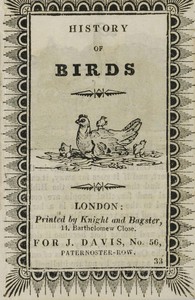
Before opening History of Birds — Text and Context, the edition data offers a quick orientation: 4,376 words, 20 min estimated reading time, and 1 detected text section.
The text analysis averages about 25.2 words per sentence, while the detected sections provide another way to judge how the source is divided.
Project Gutenberg metadata also associates the work with “Birds -- Juvenile literature,” connecting these edition facts with the source record’s subject description.
Explore this collection
These alternatives are selected using recorded categories and estimated reading time.
About 19 minutes
Birds
4,194 recorded words. 1 minutes difference from this book's estimate.
View Gutenberg source #73392About 32 minutes
Birds
7,230 recorded words. 12 minutes difference from this book's estimate.
View Gutenberg source #54487About 46 minutes
Birds
10,396 recorded words. 26 minutes difference from this book's estimate.
View Gutenberg source #49876Search stored excerpts and compare books → Choose by your preferences →
Choices use stored catalog measurements. Estimates vary with reading speed. A shared category is a catalog label, not a claim that two books have the same argument or literary quality.
Search reads excerpt text stored with this catalog and links to its associated Gutenberg record. The connection is stored in the site database; this tool does not recheck that every excerpt is word-for-word identical to that external record. Excerpt search does not cover every chapter and does not verify historical publication dates.
Catalog snapshot checked: 2026-09-26. Coverage: 96 public books, 96 available source excerpts.
Calculated from edition completeness, EPUB availability, text structure and catalogue metadata. Not a user rating.
Total of 100 points, scaled to a 2.5-5.0 range. Editions with an empty description or a missing EPUB file are not scored.
Public-domain source text
The source text is kept in the dedicated reader, separate from this catalogue record and its commentary.
This anonymous 19th-century work, printed for J. Davis in London, is not a natural history but a moral catechism dressed in feathers. Each bird entry follows a rigid three-part structure: a brief observation of the bird’s behavior, a verse from the Bible, and an explicit lesson for children. The Ostrich, for instance, is noted for hiding its head in a bush, then compared to people who “act as if we thought God did not see us.” The catalog subjects—Birds, Christian life, and Children—Conduct of life—are accurate, but the excerpts reveal that the bird content is subordinate to the moral instruction. The book’s voice is direct and parental, addressing “my little readers” and assuming a shared Christian framework.
The excerpts show that each bird is introduced primarily to illustrate a moral or spiritual failing. The Peacock is not described for its plumage but as a warning against vanity: “I suppose that little girl is proud of her finery, and the little boy tells her she is like the Peacock.” The Goose, though “generally thought a silly bird,” becomes a lesson in not judging by appearances: “those who appear to be dull, are superior in many things.” The Swallow’s migration is used to contrast the bird’s obedience to God’s timing with human forgetfulness of Scripture. The Quail, a “small bird, and very pleasant to eat,” triggers a retelling of Numbers 11, where the Israelites’ craving for meat led to a plague. In every case, the natural fact is a springboard for a sermonette aimed at child conduct.
The narrator repeatedly speaks directly to “my little readers” and imagines specific child behaviors: a girl proud of finery, a boy teasing her, children frightening geese. This suggests the book was intended for home or Sunday school reading, with an adult voice guiding a child’s interpretation. The lessons are blunt: “I hope my little readers will remember this” follows the warning about disobeying parents. The text assumes a shared biblical literacy—citing Job, Proverbs, and the Exodus story without explanation—and expects children to recognize the references. The moral framework is consistently Protestant and didactic, with an emphasis on personal sin, divine punishment, and gratitude.
Each entry follows an unvarying pattern: (1) a simple statement about the bird, (2) a Bible verse or story, (3) an application to the child’s life. For example, the Eagle entry begins “The Eagle is a bird of prey; it is violent and strong,” then quotes Job 39:27 and Proverbs 30:17, and concludes that God “makes use of wicked people, to punish others who despise his word.” The repetition reinforces the idea that all of nature is a moral text. The book’s brevity—each bird gets only a paragraph—means the natural details are minimal; the focus is on the lesson. This structure makes the work more a series of homilies than an encyclopedia, and the catalog subject “Birds” is best understood as a vehicle for the other two subjects.
Readers approaching this text should expect a devotional primer, not a field guide. The bird facts are often inaccurate or oversimplified (the Ostrich does not hide its head), but the book’s purpose is not ornithological. It belongs to a genre of 19th-century children’s religious literature that used animals as moral exemplars. The consistent structure and direct address make it easy to read aloud, and the biblical references invite cross-referencing. The work is best appreciated as a period artifact of how nature was enlisted to teach obedience and faith.
Reading History of Birds, I remembered sitting on a porch swing with my grandfather, who believed every sparrow carried a sermon. That old patience—bird, verse, lesson—felt like a hand on my shoulder. Later, Some Common Birds Useful to the Farmer (1915 edition) — Themes and Context stirred the same quiet hush, a different kind of reverence, still about paying close attention.
Your answers remain private and are stored only in this browser.









