About 94 minutes
Some Common Birds Useful to the Farmer (1926 edition) — Reading Companion
Birds
21,546 recorded words. 2 minutes difference from this book's estimate.
View Gutenberg source #62678
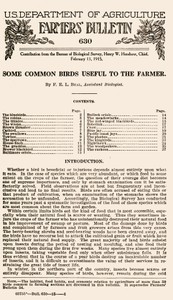
The catalog record for Some Common Birds Useful to the Farmer (1915 edition) — Themes and Context provides practical reading context through 20,947 words, 1 hr 32 min estimated reading time, and 4 detected text sections.
The text analysis averages about 21.2 words per sentence, while the detected sections provide another way to judge how the source is divided.
Project Gutenberg metadata also associates the work with “Birds -- United States,” connecting these edition facts with the source record’s subject description.
Explore this collection
These alternatives are selected using recorded categories and estimated reading time.
About 94 minutes
Birds
21,546 recorded words. 2 minutes difference from this book's estimate.
View Gutenberg source #62678About 104 minutes
Birds
23,899 recorded words. 12 minutes difference from this book's estimate.
View Gutenberg source #21266About 76 minutes
Birds
17,299 recorded words. 16 minutes difference from this book's estimate.
View Gutenberg source #52382Search stored excerpts and compare books → Choose by your preferences →
Choices use stored catalog measurements. Estimates vary with reading speed. A shared category is a catalog label, not a claim that two books have the same argument or literary quality.
Search reads excerpt text stored with this catalog and links to its associated Gutenberg record. The connection is stored in the site database; this tool does not recheck that every excerpt is word-for-word identical to that external record. Excerpt search does not cover every chapter and does not verify historical publication dates.
Catalog snapshot checked: 2026-09-26. Coverage: 96 public books, 96 available source excerpts.
Calculated from edition completeness, EPUB availability, text structure and catalogue metadata. Not a user rating.
Total of 100 points, scaled to a 2.5-5.0 range. Editions with an empty description or a missing EPUB file are not scored.
Public-domain source text
The source text is kept in the dedicated reader, separate from this catalogue record and its commentary.
The bulletin opens with a clear methodological premise: whether a bird is beneficial or injurious depends almost entirely on what it eats. Rather than relying on field observations, which the author calls "fragmentary and inconclusive," the Bureau of Biological Survey conducted systematic stomach examinations. This evidence-based approach sets the tone for the entire work, which moves from general principles to detailed species accounts.
The structure follows a logical progression: an introduction outlining the importance of diet analysis, then individual entries for each bird group. Each entry typically includes a physical description, habitat notes, and a breakdown of stomach contents by percentage. The recurring image of the stomach as a courtroom—where accusations are confirmed or refuted—gives the bulletin a distinctive forensic quality.
The bulletin’s structure mirrors its scientific method. The introduction establishes a framework: birds eat what is most accessible, and damage to crops often results from farmers destroying natural food sources. This principle recurs throughout the species accounts. For example, the red-winged blackbird entry notes that complaints against it are regionally uneven—heavy in the upper Mississippi Valley but absent in the Northeast. The author then presents stomach data: only 13 percent grain, with weed seeds forming 57 percent of the annual diet. The structure thus moves from accusation to evidence, letting the numbers speak.
Each species account follows a similar pattern: a brief physical description (length, sometimes weight), geographic range, then a detailed food analysis. The consistency of this structure allows readers to compare species directly. The bobolink entry, for instance, contrasts its romantic reputation in New England with its vilification in the South for rice-eating. The stomach evidence shows that in the North, it eats mainly insects and weed seeds, attacking grain only minimally.
A striking feature of the bulletin is its repeated use of the stomach as a source of objective truth. The introduction states that only stomach examination can "satisfactorily" solve the question of diet. This image recurs in nearly every species account. For the red-winged blackbird, examination of 1,083 stomachs reveals that vegetable matter forms 74 percent of the food, with animal matter at 20 percent. The author then breaks down the insect portion: beetles (mostly harmful) at 10 percent, weevils at 4 percent, grasshoppers at nearly 5 percent.
The stomach data also serves to counter popular accusations. The red-wing is accused of grain damage, but the evidence shows it eats less than one-eighth grain—far less than the purple grackle or crow. The author notes that weevil destruction "should condone some, at least, of the sins of which the bird is accused." This courtroom language—"accused," "sins," "condone"—turns each species account into a mini-trial, with the stomach contents as the decisive exhibit.
The bulletin frequently shifts between geographic regions and seasonal contexts, reflecting the migratory patterns of the birds it describes. The bobolink entry exemplifies this: it is a "rollicking songster" in New England June meadows, but in the South it is cursed for its rice-eating. The author traces its seasonal diet: during nesting, insects dominate; after the young fledge, the family gathers into flocks and shifts to weed seeds; as autumn advances, they move southward. This movement between scenes—from meadow to rice field, from summer to winter—gives the bulletin a dynamic quality.
Similarly, the red-winged blackbird entry notes that complaints come mainly from the West, not the Northeast. The author explains that the bird is less abundant in the Northeast, implying that regional abundance shapes perception. The bulletin thus uses geographic movement to highlight how the same species can be viewed differently depending on location and season.
Throughout the bulletin, the author builds an economic case for bird protection. The introduction states that birds destroy "an incalculable number of insects" and that their value in restraining insect life is "difficult to overestimate." This argument is reinforced with specific data. For the red-winged blackbird, weed seeds form 57 percent of the annual diet, with ragweed, barnyard grass, and smartweed as principal items. The author notes that the birds begin eating these seeds in August, when grain is still available, and continue even after insects become plentiful in April—showing a clear preference for weeds over crops.
The bobolink similarly eats weed seeds in the North, and its insect consumption during nesting is emphasized. The bulletin’s recurring message is that birds provide a free service: they eat the seeds of weeds that farmers would otherwise have to control, and they eat insects that damage crops. The stomach data quantifies this service, making the economic argument concrete. The author concludes that nearly seven-eighths of the red-wing’s food consists of weed seeds or injurious insects, indicating that the bird "should be protected, except, perhaps, in a few places where it is overabundant."
This bulletin is best read as a series of evidence-based case studies rather than a continuous narrative. Readers interested in a particular species can jump directly to its entry, as each is self-contained. The introductory section provides essential context for understanding the methodology and the economic stakes. The work rewards attention to the percentages and the author’s careful distinctions between accusation and proof. It remains a model of how to turn stomach contents into a compelling argument for conservation.
Flipping through that old 1915 bulletin, I kept thinking how each bird’s stomach contents told a quiet story of place—the farm’s rhythm written in beakfuls of insects. It made me recall another volume, one that unfolded islands instead of fields. A Manual of Philippine Birds — Context and Discussion holds that same patient spirit, cataloguing creatures by what they eat and where they flit.
Your answers remain private and are stored only in this browser.









