
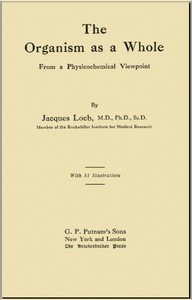
The Organism as a Whole, from a Physicochemical Viewpoint by Jacques Loeb
Let's be clear from the start: this isn't a novel. There's no plot in the traditional sense. Instead, think of it as a manifesto. Jacques Loeb, a pioneering biologist, lays out his grand theory of life. He argues that to truly understand an animal or a plant, you can't just study its parts in isolation. You have to see it as a complete, integrated system—an 'organism as a whole'—and that system obeys the same physical and chemical rules as a rock or a star.
The Story
The 'story' is Loeb's intellectual journey. He walks us through his own experiments, like making sea urchin embryos develop without fertilization (a huge deal at the time) or showing how simple chemicals can dictate an animal's behavior. Each chapter tackles a big question: growth, reproduction, instinct, even the beginnings of mind and consciousness. His goal is to connect them all, showing they are different outcomes of the same physicochemical processes. The drama comes from his relentless push against the vitalist ideas of his era, which said life required some special, non-material spark. For Loeb, that spark was just chemistry we hadn't figured out yet.
Why You Should Read It
You read this for the sheer force of the argument. Loeb isn't dry or detached; he's passionate and combative. You can feel his frustration with fuzzy thinking and his excitement when an experiment works. It's a snapshot of a pivotal moment in science, when biology began its shift from a descriptive field to an explanatory, mechanistic one. Reading it today, you'll constantly think, 'Wow, he was right about that,' or 'That's where that modern idea started.' It connects the dots between early 20th-century thought and today's fields like genetics, neuroscience, and synthetic biology.
Final Verdict
This book is not for everyone. It's dense and the science is dated in places. But it's perfect for anyone curious about the history of ideas, especially in science. If you enjoy biographies of stubborn visionaries, or if you're a student of biology who wants to understand the philosophical roots of your field, this is a rewarding challenge. Think of it less as a textbook and more as listening in on a brilliant, determined mind trying to rebuild our understanding of life from the ground up.
This text is dedicated to the public domain. Thank you for supporting open literature.
Linda Lewis
1 year agoEnjoyed every page.
Logan Moore
1 year agoFive stars!
Robert Jones
11 months agoIf you enjoy this genre, it challenges the reader's perspective in an intellectual way. Thanks for sharing this review.
Paul Williams
4 months agoEssential reading for students of this field.
Jessica Harris
1 year agoEnjoyed every page.