
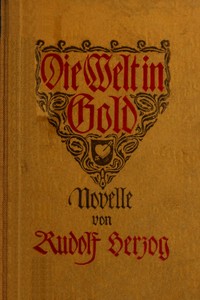
Die Welt in Gold: Novelle by Rudolf Herzog
Let's talk about this strange little book. 'Die Welt in Gold' (The World in Gold) was published in 1901, and it feels both of its time and weirdly timeless. It’s a story about alchemy, but not the magic kind—the scientific, greedy, soul-crushing kind.
The Story
We meet Dr. Felix Hell, a man who embodies the struggling artist, except his medium is chemistry. He's brilliant, passionate, and flat broke. His big dream? To finally marry his sweetheart, Lotte. His big problem? Her wealthy father won't allow it without financial security. Driven by love and desperation, Felix throws himself into his life's work: the artificial creation of gold. And against all odds, he does it. He holds the secret to limitless wealth in his hands.
But here's the twist. The gold doesn't bring the fairy-tale ending. Instead, it acts like a corrosive acid. Felix becomes paranoid, secretive, and isolated. The pure love that motivated him gets tangled up in lies and a growing obsession with power. The man who wanted gold to build a life finds that the gold is dismantling him, piece by piece. The climax isn't a celebration; it's a chilling look at what remains when a dream consumes the dreamer.
Why You Should Read It
What grabbed me wasn't the science, but the psychology. Herzog writes Felix not as a villain, but as a tragically relatable figure. We've all wanted something so badly it hurts. Felix just gets it. And watching that victory curdle is fascinating and horrible. Herzog has a sharp eye for the small moments—a strained conversation, a suspicious glance—that show a relationship cracking under new pressure.
The book is also a snapshot of its era, buzzing with late-19th century ambition and anxiety about science and progress. But its core question—can we handle getting what we wish for?—feels completely modern. It’s a short, potent read that packs a real emotional punch.
Final Verdict
This book is perfect for readers who love classic moral fables but want something with more psychological grit. Think of it as a darker, European cousin to stories like 'The Monkey's Paw.' It's for anyone who enjoys character studies about ambition and corruption, or has a soft spot for rediscovering forgotten authors. It's not a light, happy read, but it's a compelling and thought-provoking one that sticks with you. If you find a copy, it's a worthy dive into a different kind of golden age storytelling.
Legal analysis indicates this work is in the public domain. Enjoy reading and sharing without restrictions.
George White
1 year agoI've been looking for a reliable source on this topic, and the author manages to bridge the gap between theory and practice effectively. It’s a comprehensive resource that doesn't feel bloated.
Karen Garcia
9 months agoUnlike many other resources I've purchased before, the clarity of the writing makes even the most dense sections readable. Definitely a five-star contribution to the field.
Elizabeth Williams
7 months agoAfter spending a few days with this digital edition, the narrative arc keeps the reader engaged while delivering factual content. I appreciate the effort that went into this curation.
Joseph Moore
9 months agoA must-have for graduate-level students in this discipline.




William Anderson
1 year agoI've gone through the entire material twice now, and the inclusion of diverse viewpoints strengthens the overall narrative. A trustworthy resource that I'll keep in my digital library.