
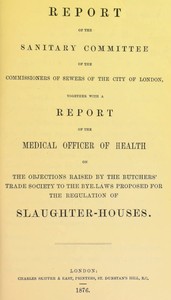
Report of the Sanitary Committee of the Commissioners of Sewers of the City of…
Forget everything you think you know about dry government documents. This book is the raw, urgent blueprint for saving a city. It’s not a narrative with characters in the traditional sense; the ‘characters’ are the facts, the statistics, and the shocking state of Victorian London itself.
The Story
The book is the official report from a committee tasked with a simple, horrifying question: why are so many Londoners getting sick and dying? The ‘plot’ follows their investigation. They walk the streets, inspect basement dwellings flooded with sewage, and document the appalling conditions where clean water is a fantasy. They present maps, death tolls, and engineering proposals. The central conflict isn't person-against-person, but progress-against-tradition and science-against-superstition. The climax isn't a battle, but a recommendation: London must build a completely new, coordinated sewer system to wash the waste away. It’s the argument that convinced a city to undertake one of the biggest engineering projects in history.
Why You Should Read It
This book is powerful because it captures a turning point in human thought. You’re reading the moment we started to truly understand how cities work and how public health is built, not by chance, but by design. The passion in the report is palpable. You can feel the committee’s frustration and their determination to make people see the invisible link between filth and disease. It’s a foundational text for our modern world. Reading it, you gain a profound appreciation for the invisible infrastructure we take for granted. Every time you turn on a tap or flush a toilet, you’re seeing the legacy of the ideas fought for in these pages.
Final Verdict
This is a must-read for anyone fascinated by history, cities, or medicine. It’s perfect for fans of non-fiction that reads like a puzzle, like The Ghost Map by Steven Johnson (which tells a related story). It’s also great for readers who enjoy seeing how big, messy problems get solved through careful observation and sheer stubbornness. If you’ve ever wondered how we went from throwing waste into the street to having clean, functioning cities, this is the ground-level report. It’s a short, impactful book that will change how you see the world beneath your feet.
This masterpiece is free from copyright limitations. Use this text in your own projects freely.
Christopher Brown
3 months agoI was particularly interested in the case studies mentioned here, the attention to detail regarding the core terminology is flawless. Simple, effective, and authoritative – what else could you ask for?
Elizabeth Martinez
3 weeks agoThe citations provided are a goldmine for further academic study.
Margaret Jackson
9 months agoI appreciate how this edition approaches the core problem, the level of detail in the second half of the book is truly impressive. Finally, a source that prioritizes accuracy over hype.
Michelle Thomas
2 months agoCitation worthy content.







Michael Garcia
6 months agoThe balance between academic rigor and readability is perfect.