About 211 minutes
Bird studies with a camera — Context and Discussion
Birds
48,462 recorded words. 13 minutes difference from this book's estimate.
View Gutenberg source #75287
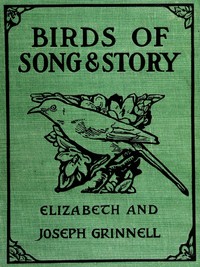
The source record for Birds of Song and Story — Reading Notes measures this digital text at 45,365 words, 3 hr 18 min estimated reading time, and 6 detected text sections.
The text analysis averages about 21.8 words per sentence, while the detected sections provide another way to judge how the source is divided.
Project Gutenberg metadata also associates the work with “Birds -- Juvenile literature,” connecting these edition facts with the source record’s subject description.
Explore this collection
These alternatives are selected using recorded categories and estimated reading time.
About 211 minutes
Birds
48,462 recorded words. 13 minutes difference from this book's estimate.
View Gutenberg source #75287About 216 minutes
Birds
49,634 recorded words. 18 minutes difference from this book's estimate.
View Gutenberg source #60646About 220 minutes
Birds
50,511 recorded words. 22 minutes difference from this book's estimate.
View Gutenberg source #46825Search stored excerpts and compare books → Choose by your preferences →
Choices use stored catalog measurements. Estimates vary with reading speed. A shared category is a catalog label, not a claim that two books have the same argument or literary quality.
Search reads excerpt text stored with this catalog and links to its associated Gutenberg record. The connection is stored in the site database; this tool does not recheck that every excerpt is word-for-word identical to that external record. Excerpt search does not cover every chapter and does not verify historical publication dates.
Catalog snapshot checked: 2026-09-26. Coverage: 96 public books, 96 available source excerpts.
Calculated from edition completeness, EPUB availability, text structure and catalogue metadata. Not a user rating.
Total of 100 points, scaled to a 2.5-5.0 range. Editions with an empty description or a missing EPUB file are not scored.
Public-domain source text
The source text is kept in the dedicated reader, separate from this catalogue record and its commentary.
The Grinnells open Birds of Song and Story with a poem that immediately establishes a lyrical, personifying voice: birds are described as swaying in marshes, nesting in the elbow of scrub-oaks, and sitting on church spires. The authors then present a creation myth in which Nature distributes gold dust to plain little birds, explaining the yellow warbler’s bright plumage and cheerful disposition. This blend of factual observation and imaginative narrative characterizes the entire work.
The book begins with Elizabeth Grinnell’s poem “The Birds,” which catalogs habitats—marshes, arroyos, canyons, sea beaches—and ends with the line “my heart is like a nest.” This poetic frame is not decorative but structural: the prose chapters that follow often echo the poem’s imagery and tone. For instance, the yellow warbler’s story is told as a fable, complete with moralizing about feather-collecting. The authors treat birds as characters with missions, like the “summer yellowbird” who is commanded to “make the earth glad.” This approach aligns with the catalog subject “Birds – Juvenile literature,” but the excerpts show the Grinnells using verse and allegory to teach identification and behavior, not just to entertain.
Several passages in the excerpts carry explicit ethical messages. In the yellow warbler fable, Nature rewards the unselfish female birds who forgo gold for their mates. Later, the authors warn against collecting feathers: “to rob a bird of its gold, to tear out a wing or a feather to flaunt on your own pitiless head—that would be a different thing.” This direct address to “girls and some women” suggests the book’s intended audience and its didactic purpose. The Grinnells use bird behavior as a springboard for lessons on generosity, cruelty, and stewardship, making the work as much a moral primer as a natural history guide.
The excerpts reveal that the Grinnells frequently incorporate folkloric elements into their species accounts. The yellow warbler’s origin story is presented as “a story afloat,” and the authors mention that “birds do hold conventions for the supposed purpose of talking over matters that concern themselves.” This blending of scientific observation with imaginative narrative is a deliberate technique: it makes the information memorable for young readers while acknowledging that some tales are not “believed by everybody.” The book thus occupies a middle ground between field guide and storybook, using myth to spark curiosity about real avian behaviors.
Readers interested in the intersection of literature and natural history will find Birds of Song and Story an instructive example of early twentieth-century nature writing for children. The Grinnells’ method—pairing accurate description with allegory—offers a window into how bird study was once popularized. For modern audiences, the book’s value lies less in its scientific currency than in its cultural and pedagogical approach.
Rain blurred the window while I turned pages of Birds of Song and Story, its folk tales mingling with the sparrows outside. That quiet blending of observation and legend stayed with me. Later, I found myself similarly lost in The Birds of Australia, Vol. 3 of 7 — Reading Notes, the same patient wonder, just a different sky. The drizzle never stopped. Neither did I.
Build a private reading journal entry for this title.









