About 164 minutes
Tales About Birds, Illustrative of Their Nature, Habits, and Instincts — A Reader’s Guide
Birds
37,611 recorded words. 2 minutes difference from this book's estimate.
View Gutenberg source #61808
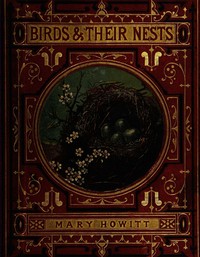
The source record for Birds and their nests — Text and Context measures this digital text at 37,224 words, 2 hr 42 min estimated reading time, and 25 detected text sections.
The text analysis averages about 29.1 words per sentence, while the detected sections provide another way to judge how the source is divided.
Project Gutenberg metadata also associates the work with “Natural history -- Juvenile literature,” connecting these edition facts with the source record’s subject description.
Explore this collection
These alternatives are selected using recorded categories and estimated reading time.
About 164 minutes
Birds
37,611 recorded words. 2 minutes difference from this book's estimate.
View Gutenberg source #61808About 174 minutes
Birds
39,903 recorded words. 12 minutes difference from this book's estimate.
View Gutenberg source #45630About 175 minutes
Birds
40,244 recorded words. 13 minutes difference from this book's estimate.
View Gutenberg source #47191Search stored excerpts and compare books → Choose by your preferences →
Choices use stored catalog measurements. Estimates vary with reading speed. A shared category is a catalog label, not a claim that two books have the same argument or literary quality.
Search reads excerpt text stored with this catalog and links to its associated Gutenberg record. The connection is stored in the site database; this tool does not recheck that every excerpt is word-for-word identical to that external record. Excerpt search does not cover every chapter and does not verify historical publication dates.
Catalog snapshot checked: 2026-09-26. Coverage: 96 public books, 96 available source excerpts.
Calculated from edition completeness, EPUB availability, text structure and catalogue metadata. Not a user rating.
Total of 100 points, scaled to a 2.5-5.0 range. Editions with an empty description or a missing EPUB file are not scored.
Public-domain source text
The source text is kept in the dedicated reader, separate from this catalogue record and its commentary.
Mary Howitt opens Birds and Their Nests by declaring that nests are 'wonderful things,' and her book proceeds to prove it species by species. Rather than a dry catalogue, each chapter pairs a full-page illustration by Harrison Weir with a close study of a single bird—its nest, eggs, song, and habits. Howitt draws on her own observations, her husband's writings, and naturalists like Gilbert White and the Rev. J. G. Wood, weaving together precise natural history with a quiet sense of wonder.
The structure is deliberate: after an introductory chapter on nests in general, twenty-two chapters each treat one bird, from the wren to the nuthutch. Howitt's voice is that of an informed companion, pointing out what to look for in hedgerow and copse, and why the chiff-chaff's 'chiff-chaff' or the skylark's song matters as a sign of returning spring.
Howitt insists that every bird builds 'exactly alike' within its kind, yet no two families build the same way. The nest is not just a home but a signature: the wren's domed structure, the chiff-chaff's 'hollow ball' with a side entrance, the house-martin's mud cup under the eaves. She marvels that birds have 'no implements to work with—no needle and thread, no scissors, no hammer and nails'—only feet and beak. This emphasis on material and method gives each chapter a forensic quality: the reader learns to identify a nest by its construction as much as by its occupant.
The chiff-chaff chapter exemplifies this. Howitt describes the nest as 'a hollow ball wonderfully put together, of dry leaves and stems of grass, and a circular hole for entrance at the side; lined with soft feathers.' She notes that the nest is 'not unlike that of a wren' but built in a low bush or even on the ground. Such comparisons recur throughout, building a field guide in prose.
Howitt treats bird song as a seasonal marker. The chiff-chaff's 'incessant “chiff-chaff,” “chery-charry”' is 'one of the first visitants of spring,' heard 'through the yet leafless trees.' She quotes her husband: 'Its cheery little voice is one of the pleasantest recognitions of returning spring.' The skylark and nightingale receive similar treatment, their songs tied to specific months and moods.
This is not mere poetry. Howitt uses song to establish a bird's place in the natural calendar and to guide the reader's ear. She notes that the chiff-chaff arrives as early as March 12 and stays until mid-October, longer than other warblers. The song becomes a reliable sign, 'sure to be heard, just as in former years, in the copse, the dell, the belt of trees bordering a wayside.' For Howitt, listening is a form of knowing.
Howitt balances aesthetic appreciation with practical ecology. The chiff-chaff 'is very useful to man, and should be made kindly welcome everywhere, living entirely on caterpillars and other troublesome and destructive creatures.' She cites the Rev. J. G. Wood on how the bird saves oaks by devouring caterpillars of the green oak-moth. A tame chiff-chaff, she reports, would 'dash to the ceiling' to catch flies.
Yet utility never overshadows memory. Howitt's husband recalls 'the pleasure with which we examined its little circular entrance, and discovered, in its downy interior, its store of delicate eggs.' The book is threaded with such recollections—boyhood rambles, the 'bosky dingle,' the 'bleached bents of last year's grasses.' These personal notes give the natural history a retrospective warmth, as if each bird carries a trail of remembered springs.
Howitt's book rewards a slow, chapter-by-chapter reading, ideally with a notebook and a window onto a garden or hedgerow. The illustrations by Harrison Weir are integral—study them alongside the text to see how nest and bird are placed in their setting. Readers familiar with British birds will find old acquaintances newly observed; newcomers will gain a vocabulary for looking and listening. The book is best taken as a companion for walks, not a reference to be consulted in haste.
Reading about the wren's domed nest, I remembered my grandmother's garden in April—how she'd point out that hidden cup of moss, asking me to guess whose home it was. That feeling returned with Birds of Britain — Edition Insights, which quietly reminded me of another book, one that made me see hedgerows as rooms, not borders. Strange, how words can make a landscape feel inhabited.
Your answers remain private and are stored only in this browser.









